

Stewardship: The forever work of conservation
May 6, 2026
Trail Forum Honors Dedicated Supporters
May 6, 2026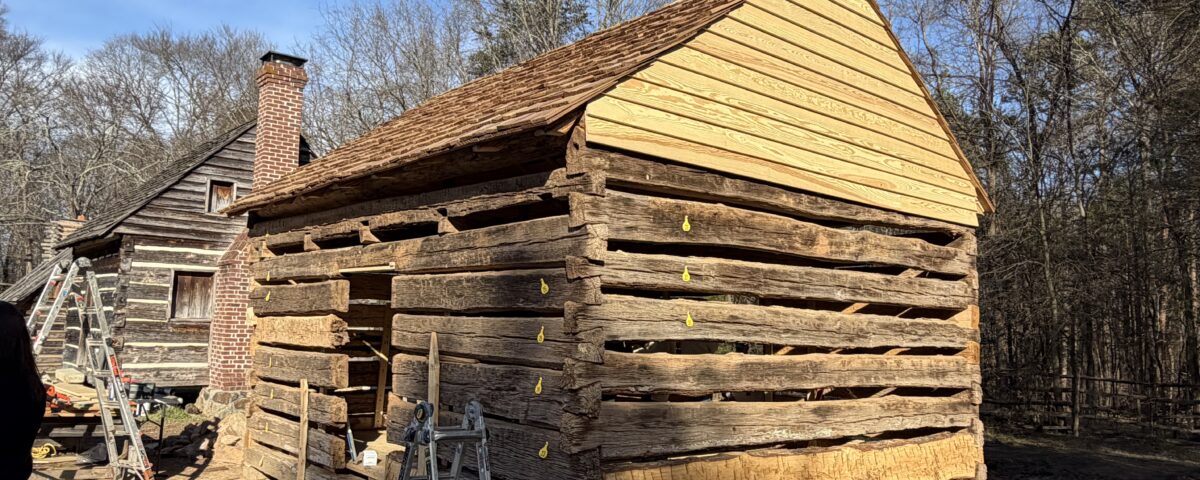
Against a Carolina-blue sky, the bright hues of newly worked oak starkly contrast wood worn dark by 150 years of exposure, but the axe marks on both are real. Led by Austin Kirkland, the craftsmen of Spotted Dog Timber Frames have hand-hewed replacement logs using historically accurate tools, echoing the work of a small but historically significant cabin’s original builders.
Built of hand-hewn red and white oak, the cabin began its life in the mid-to-late 1800s as a dwelling for the enslaved people of the Stafford-Holcombe Farm. It is the last known structure of its kind in Mecklenburg County, and like so many buildings tied to enslaved lives, it could have disappeared entirely to neglect, time, or development.
In 1860, enslaved people made up roughly 40% of Mecklenburg County’s population, forming a foundational yet often underrepresented part of its history. The physical spaces where enslaved people lived, however, have largely vanished. Small, undervalued, and rarely maintained, these structures disappeared alongside the land itself.
That didn’t happen to this cabin because of the care and conviction of the landowner, Leslie Freeman. Having inherited the property from close family friends, she recognized its significance and stewarded it with quiet dedication. In 2022 she decided to partner with the Conservancy to place the land under conservation easement. Later she collaborated with Mecklenburg County to relocate and restore the cabin at Latta Place, ensuring that the cabin and its layered history would endure.
Once the conservation paperwork was finalized, the craftsmen began their work. Kirkland and his team deconstructed the cabin log by log, like an archaeological dig, then relocated it from the property. Roughly half the logs, too deteriorated to reuse, were replaced with locally sourced oak. Daubing made from clay, sand, and lime putty fills the gaps, just as it did over a century ago. Even a curved-handled broad axe from the 1860s was used to shape the new wood.
Reconstructed at Latta Place, this cabin now stands ready to tell its story publicly, honestly, and with care. It reminds us that land and history are inseparable, and that preservation begins with individuals who choose to care, to act, and to ensure that stories like this one are not lost. Conservation made this possible, but people make conservation possible.